Twin Flames, Soul Mates, and the Tarot: A Clearer Way to Understand Connection
The Language of Soul Connection
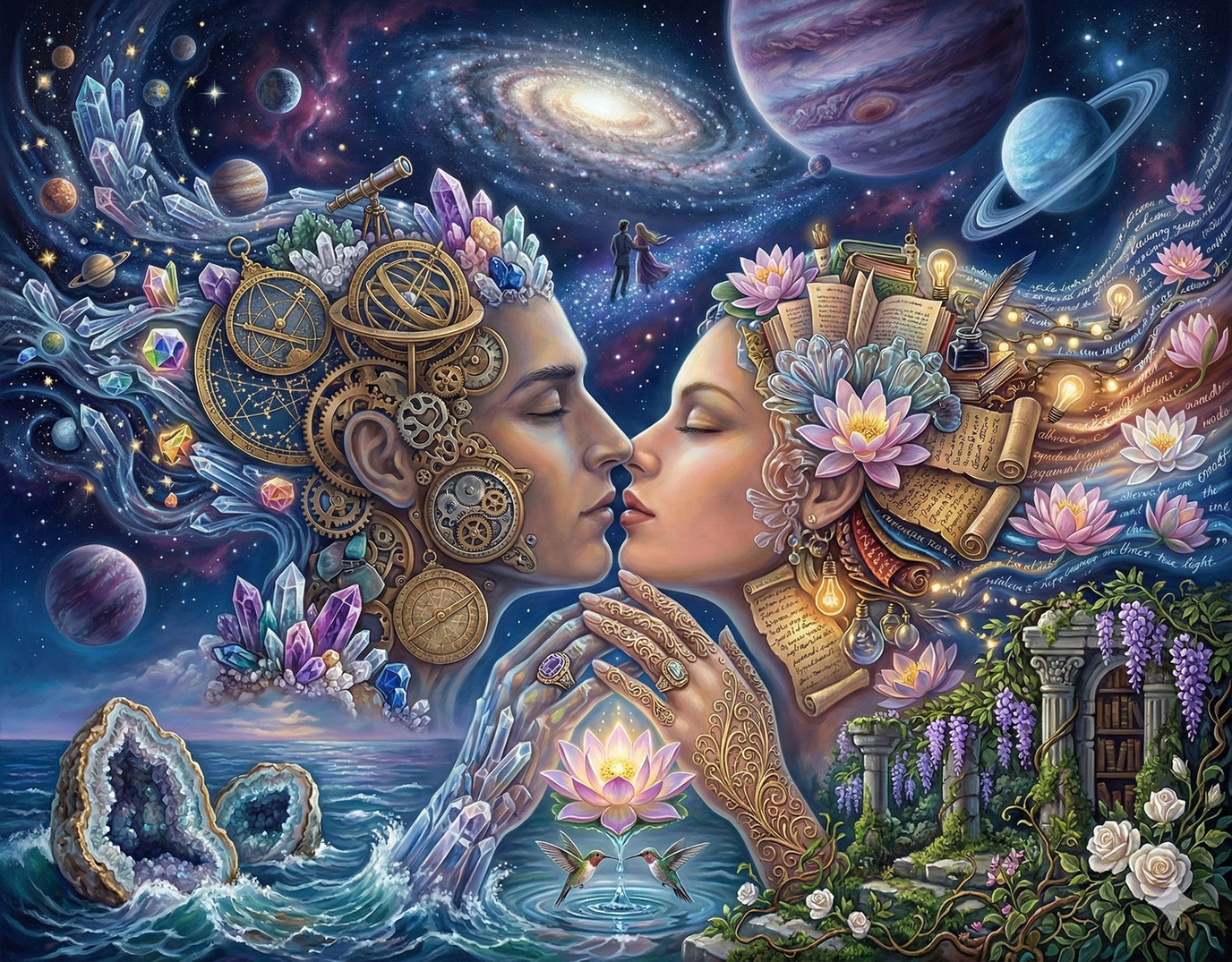
People reach for the language of “twin flames” and “soul mates” when they are trying to make sense of an experience that feels larger than their ordinary emotional vocabulary. These terms promise a kind of metaphysical architecture for longing: a way to explain intensity, timing, synchronicity, and the strange gravitational pull that certain people exert on us. They offer a story that feels more coherent than the chaos of desire. Yet the very narratives that soothe can also distort. They can turn uncertainty into destiny, ambivalence into spiritual testing, and emotional pain into evidence of cosmic significance.
In tarot readings, I meet people who are not looking for fantasy; they are looking for clarity. They want to understand why a connection feels powerful, why someone left, why someone returned, why the timing feels impossible, or why they cannot let go. They want language that helps them move, not language that keeps them suspended in a myth.
Mythologic Evolution
The modern mythology of twin flames and soul mates did not emerge from nowhere. The soul mate idea has deep historical roots, shaped by ancient philosophical attempts to explain the ache of incompleteness. Plato’s Symposium imagined humans as once-whole beings split apart by the gods, condemned to search for their missing half. The story was never meant to be literal; it was a metaphor for the human condition — the sense that something in us is always reaching, always seeking, always yearning for recognition.
Later traditions softened the myth but kept the longing: the idea that somewhere, someone is meant for you. The twin flame narrative, by contrast, is a contemporary invention. It arose in the late twentieth century, shaped by New Age spirituality, metaphysics, and the language of ascension.
It reframed connection as a spiritual mission: two souls originating from the same energetic source, separated, incarnated, and destined to reunite for collective awakening. The story is dramatic, emotionally charged, and deeply appealing to anyone who has experienced a connection that feels bigger than logic. But both frameworks share a structural flaw: they externalise the source of meaning. They imply that the value of a connection comes from its cosmic origin rather than from the lived reality of two people navigating each other’s humanity. They shift the centre of gravity away from agency and toward destiny.
And this is where the trouble begins. When people adopt these narratives, they often start interpreting suffering as spiritual significance. They stay in relationships that are not relationships. They wait for someone who is not choosing them. They confuse longing with purpose, chemistry with compatibility, emotional activation with spiritual connection. The language that was meant to explain becomes a cage.
In Practice
In practice, when someone asks, “Is this my twin flame?” they are really asking about why the connection feels so strong, why they cannot let go, why the timing feels impossible, why the story feels unfinished. They are asking for a way to understand the emotional architecture of an experience that has unsettled them.
The twin flame and soulmate labels offer quick answers, but they also collapse complexity into a single, predetermined narrative. They turn the living dynamics of a relationship into a script. They remove the possibility of growth, change, or choice. They replace inquiry with inevitability.
A more grounded and humane framework begins with a different question: not “Who is this person to me?” but “What is the readiness of each person involved?” This is the foundation of soul‑readiness.
Soul-Readiness
Soul‑readiness is not about destiny or cosmic pairing but about capacity — the capacity to be present, to communicate honestly, to take responsibility for one’s emotional landscape, to tolerate vulnerability, to navigate conflict, to choose rather than react, to stay rather than flee, to recognise one’s own patterns rather than project them onto the other. Two people can feel an extraordinary connection and still not be ready for each other. Two people can feel ordinary at first and grow into something extraordinary because they are ready. Intensity does not equal compatibility. Timing shapes everything. And readiness — not destiny — determines whether a connection can live in the real world.
Soul‑readiness restores agency. It allows people to understand their relationships without collapsing into fatalism. It acknowledges that a connection can be meaningful without being permanent, powerful without being destined, unforgettable without being “the one.” It reframes the experience of longing as information rather than instruction. It recognises that some connections are transformative precisely because they are temporary. It understands that timing is not punishment and that love is not a test. It honours the emotional truth of intensity without turning it into a spiritual obligation.
Tarot and Zammtopia
In Zamtopia, tarot becomes especially useful in this reframed landscape because it does not confirm cosmic contracts. It does not label people as twin flames or soul mates. It does not assign spiritual missions to romantic longing. Instead, tarot illuminates the internal dynamics of a connection. It reveals the emotional landscape: what is felt, what is unspoken, what is avoided, what is projected. It clarifies readiness rather than destiny. It shows patterns rather than labels. It helps people distinguish between what is real and what is imagined, what is mutual and what is one‑sided, what is possible and what is fantasy. Tarot becomes a tool for understanding rather than justification.
The Psychology of Soul Connections
The psychological mechanisms that make certain connections feel “fated” are powerful precisely because they operate beneath conscious awareness. People often assume that intensity signals destiny, when in fact intensity frequently signals familiarity — not the familiarity of comfort, but the familiarity of an old emotional pattern resurfacing. A person can feel instantly significant because they mirror an unresolved part of us, evoke a childhood dynamic, or activate a dormant fear. The body recognises the pattern before the mind does, and the recognition is misinterpreted as cosmic significance. The experience feels larger than life because it is larger than the present moment; it is carrying the weight of the past. When this happens, the connection becomes a stage on which old wounds reenact themselves under the guise of spiritual purpose.
This is not to diminish the significance of the experience. On the contrary, the intensity reveals something important: the connection has touched a part of the psyche that is rarely accessed in ordinary relationships. It has activated a developmental edge — a place where growth is possible but not guaranteed. The twin flame narrative collapses this complexity into a single metaphysical explanation, but the developmental perspective expands it. It shows that the connection is not a cosmic reunion but a psychological threshold. It invites the person to examine the internal structures that shape their relational behaviour. It asks them to consider whether the connection is calling them forward or pulling them back into familiar patterns. It reframes the experience as an opportunity for self‑understanding rather than a mandate for union.
Cultural Context
The cultural context further complicates this landscape. Modern relationships exist in a paradoxical environment: people have more freedom than ever to choose their partners, yet the conditions that support long‑term relational stability have eroded. Economic precarity, digital communication, shifting social norms, and the decline of shared community structures have created a relational environment defined by both abundance and uncertainty. In this environment, people often oscillate between craving connection and fearing entanglement. They want intimacy but struggle to trust it. They want freedom but fear loneliness. They want certainty but live in a world that offers none. The twin flame narrative emerges as a cultural response to this instability. It promises a kind of relational inevitability that modern life no longer provides. It offers a mythic frame for experiences that feel too intense to dismiss and too inconsistent to rely on.

But mythic frames can obscure as much as they illuminate. They can turn emotional complexity into spiritual destiny, making it harder for people to see the relational truth in front of them. They can encourage people to endure dynamics that are emotionally harmful because the narrative tells them that the suffering is meaningful. They can lead people to interpret ambivalence as a sign of depth rather than a sign of incompatibility. They can turn the ordinary challenges of human connection into metaphysical tests that must be endured rather than understood. In this sense, the twin flame narrative can function as a form of emotional bypassing — a way to avoid confronting the real developmental work that relationships require.
Soul-readiness
Soul‑readiness offers a different path. It acknowledges that relationships are not determined by destiny but by the intersection of two people’s developmental trajectories. It recognises that timing is not a cosmic test but a reflection of where each person is in their emotional evolution. It understands that a connection can be profound and still be impossible because the conditions for its flourishing do not yet exist. It invites people to examine their own readiness with honesty: their capacity to communicate, to regulate their emotions, to take responsibility for their patterns, to choose with intention rather than react from fear. It invites them to consider the other person’s readiness without idealisation or projection. It reframes the connection as a meeting of two evolving systems rather than a reunion of two predestined halves.
Tarot becomes a powerful ally in this process because it reveals the emotional truth beneath the narrative. It shows the patterns that shape the dynamic, the fears that drive the behaviour, the hopes that colour the perception. It clarifies what is mutual and what is imagined, what is emerging and what is repeating, what is possible and what is blocked. It does not tell people who they are destined to be with; it shows them who they are becoming in the presence of another. It illuminates the developmental edge that the connection has activated. It helps people understand whether the connection is calling them forward or pulling them back into familiar patterns. It offers clarity without collapsing complexity.
The most profound shift occurs when the person recognises that the meaning of the connection does not depend on its outcome. A relationship can be transformative even if it does not become a partnership. A moment of recognition can change the trajectory of a life even if the two people never reunite. A brief encounter can reveal a truth that years of introspection could not. The value of the connection lies in what it awakens, not in whether it conforms to a predetermined script. When people understand this, they are free to honour the connection without being bound by it. They can integrate the experience into their development rather than waiting for it to resolve in a particular way.
Zammtopia Philosophy Lens™
This is the essence of the Zammtopia Philosophy: meaning is not discovered in destiny but created through clarity. A connection is not significant because it is fated; it is significant because it reveals something essential about who you are, what you desire, what you fear, and what you are ready to become. The work is not to determine whether someone is your twin flame but to understand what the connection is asking of you. It may be asking you to grow. It may be asking you to let go. It may be asking you to stay present. It may be asking you to choose yourself. It may be asking you to recognise a pattern that has shaped your relationships for years. Whatever the invitation, it is grounded in your development, not in a cosmic script.
When people embrace this perspective, they move with a different kind of strength. They stop waiting for signs and start listening to themselves. They stop interpreting silence as destiny and start recognising it as information. They stop romanticising inconsistency and start valuing reciprocity. They stop clinging to narratives that keep them suspended and start choosing relationships that support their growth. They become participants in their relational lives rather than characters in a myth.
A connection can be unforgettable without being eternal. It can be transformative without being predestined. It can be meaningful without being metaphysical. And when people understand this, they are free — free to honour the connection, free to release it, free to grow from it, and free to choose relationships that align with their readiness rather than their longing.
Explore a Twin flame / soul connections Tarot Session
If you’re navigating relationship patterns, longing for deeper connection, or trying to understand the meaning behind a powerful encounter, an in‑depth tarot reading can bring clarity, grounding, and direction.

— Zamm, Founder of Zammtopia
Zamm, Founder of Zammtopia and known to many as “Tarot Zamm,” brings together tarot, lived experience, and the Zammtopia Philosophy — a modern School of Thought built on Full Engagement, personal agency, and meaningful self‑understanding.